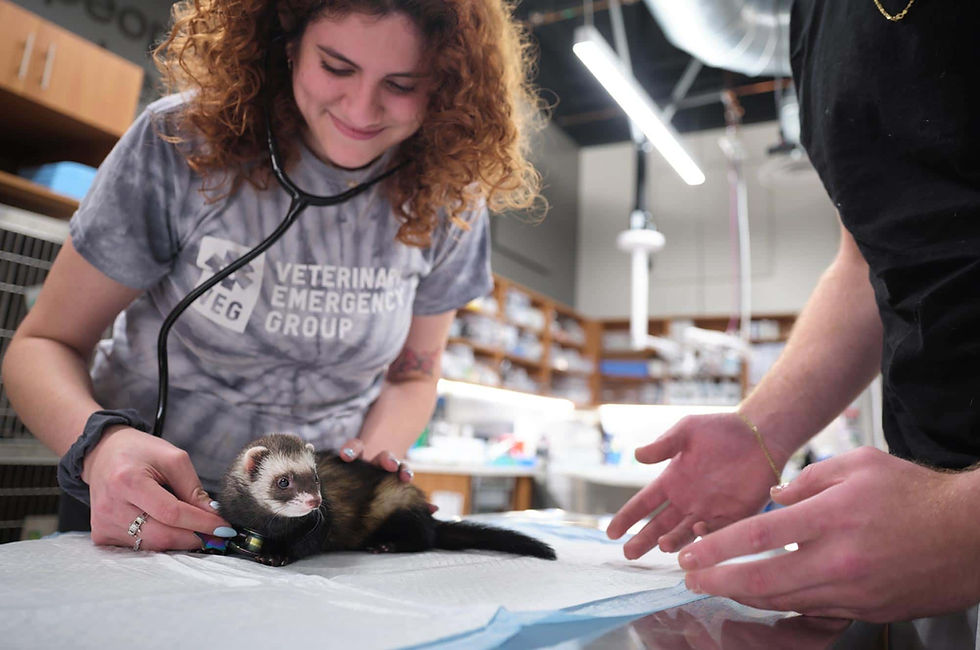
Ferrets, also known as the “kitten that never grows up,” are so much fun to have around the house. These lovable, cuddly companions require regular veterinary care, and their somewhat fragile health means going to an ER that is ferret-savvy, like VEG ER for Pets.
In this article, we’ll talk about five of the most common reasons your ferret might need to be seen at your nearest VEG emergency animal hospital. Our vets are ready 24/7 to provide prompt, compassionate care for your ferret.
5 common ferret diseases: signs and symptoms
Insulinoma in ferrets: a blood sugar crisis
We’ll start with a non-so-fun fact, but it’s one you should know. It is estimated that almost 50% of ferrets, if they live long enough, will develop an insulinoma. This disease is a malignant, slow growing tumor of the pancreas. Insulinoma disease leads to a low blood sugar, aka hypoglycemia. Note: Ferrets are obligate carnivores, so avoid feeding them fruits and vegetables since the sugar content is too high and they can’t digest the fiber properly.
Early warning signs that a ferret has an insulinoma can be very subtle and easily missed by most owners (and non-ferret knowledgeable veterinarians).
Signs of low blood sugar in ferrets include:
Glazed staring (“star-gazing”)
Dragging their hind legs
Drooling
Grinding their teeth
Trouble waking up from a deep sleep
In severe cases, ferrets may have seizures and become comatose
If your ferret has any of these signs, visit our emergency animal hospital as soon as possible. At VEG, we can make the diagnosis of an insulinoma from a simple blood glucose test. Long-term care can be managed with medication and diet, but surgery is also an option in many cases.
Studies have shown that with proper care, ferrets with an insulinoma can live more than a year after the initial diagnosis. Early detection is key to your ferret living a longer life.
Urinary tract infections (UTIs) in ferrets
A ferret that cannot urinate needs to be seen immediately, even if it is 3am—we’re open! The reason that ferrets cannot urinate is usually because the urethra, the tube that leads from the bladder to the outside of the body, is blocked. The most common reason for a male or female ferret to have a blocked urethra is due to a urinary tract stone.
Another reason for a blocked urethra in males is an enlarged prostate. No matter which condition is present, we need to find a way to get urine flowing through the urethra again. There is nothing you can do at home to make that happen, and that’s why a visit to an emergency animal hospital is essential.
The longer the urethra is blocked, the more urine that builds up in the bladder. This means increasing pain to the ferret and an increasing amount of toxins building up in the body. If this condition is not treated, most ferrets will die.
At any of our VEG vet hospital locations, our team will take radiographs and use ultrasound to determine which condition your ferret has and how best to start the flow of urine through the urethra again.
The prognosis for a urinary tract stone is excellent for return-to-normal health. An enlarged prostate prognosis is more complicated due to the different types of diseases of the prostate that can happen, and the extent of the primary disease: adrenal gland disease. This is a very complicated disease process. Your VEG emergency vet team can stabilize your ferret so you can have a more detailed discussion with your primary veterinarian about how best to manage your ferret’s enlarged prostate.
Breathing problems: dyspnea in ferrets
Older ferrets are prone to developing the type of heart disease that we see in older dogs. The heart muscle is not able to pump blood around the body and fluid builds up in the chest. Although this process can take months to develop, it’s difficult to recognize until your ferret reaches a tipping point, can no longer compensate, and breathing becomes very fast with very deep breaths.
Breathing problems in ferrets can look like:
Open-mouth breathing (a sign of extreme distress)
Increased abdominal or chest movement when breathing
Fast breathing
Noisy breathing/wheezing
Head and neck extension when breathing
If you see your ferret having difficulty breathing, please see the emergency-trained staff at VEG immediately. Your ferret will be put into an oxygenated enclosure and once stable, imaging tests will be done to determine if there is a heart problem, if the lungs are clear, and how to help your ferret start breathing more easily.
GI obstructions in ferrets
It’s cute when your ferret carries a prized, stolen possession around your home. But this cuteness disappears quickly when your ferret eats that prized possession and it gets “stuck” in the gastrointestinal tract (GIT)!
Objects stuck in the GIT need to be removed by surgery and the sooner, the better. If you think your ferret has eaten something they should not have, watch closely for these warning signs and if you see even one of them, go to your nearest VEG emergency vet immediately.
Signs of GI obstruction in ferrets
Lack of appetite
Rarely: regurgitation or vomiting
Your VEG emergency vet team will use imaging studies to see if there is a blockage of the GIT. The good news is that almost all ferrets do great with surgery to unstick what was stuck in the GIT!
Vaccine reaction in ferrets
Ferrets need vaccines yearly. This may be a surprise to most people because there is a lot of misinformation about ferrets and vaccines. Ferrets need their canine distemper and rabies virus vaccines on a regular schedule. And true to their rascally nature, ferrets have a unique way of thanking you for giving them a vaccine—they get vaccine reactions!
About one in 20 ferrets can show a reaction to either vaccine but we see it more with the distemper vaccine. In most cases, a reaction occurs within 30 minutes of receiving a vaccine. A ferret with a vaccine reaction will show some telltale signs.
Some vaccine reactions in ferrets to watch for:
Collapse
Droolig
Hair all over their body stands up
Tail may straighten way out
In severe cases, ferrets will vomit and have diarrhea, and blood may be present in both
If you suspect your ferret is having a vaccine reaction, even if it’s hours after the vaccine, please get your ferret to the emergency vet immediately. All ferrets with vaccine reactions have a great prognosis but they need to be seen immediately. This allows your veterinarian to start IV medications to reverse the changes happening in your ferret’s body due to the vaccine reaction.
VEG ER for Pets emergency vet hospital treats ferrets and all pets
The highly trained staff (VEGgies!) at VEG is always ready with 24-hour emergency veterinary care for all pets, including ferrets and other exotics. You can get your ferret high-quality emergency vet care any day, any time, including holidays and weekends, and no appointment is ever needed. Go to your nearest VEG location and your pet will be triaged immediately. There’s no waiting and worrying in a lobby; you get to stay with your ferret the entire time!